Correcting Crossbow Shots When the Wind Changes
A new chapter can change the wind direction. Keep your first correction small and separate sideways drift from a bolt that never clears the stone.
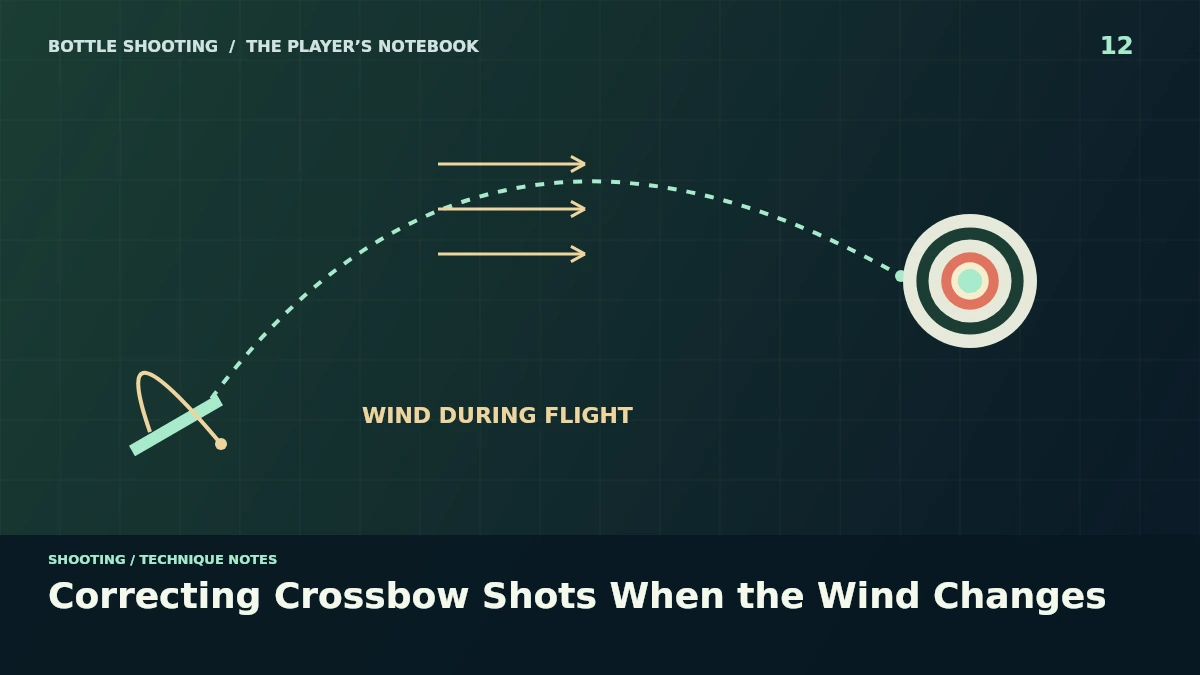
Wind acts while the bolt travels
The first chapter begins in calm air. In Crossbow Shooting, later chapters apply horizontal acceleration to the bolt during flight, so a longer airborne route gives the wind more time to act.
Read the arrow before reusing a shot. Each chapter chooses a wind direction and strength, while your launch angle and draw power determine the initial velocity that the breeze changes after release.
The strength follows the chapter number. It uses twelve plus six times the chapter, meaning chapter two shows a magnitude of 24 and chapter eight shows 60, with either sideways direction possible.
Keep charge consistent for a comparison
Charging starts at 55 percent power. Holding for 1.1 seconds reaches full draw, and the launch speed uses 460 plus 570 times that power fraction rather than starting from zero at a quick release.
A short press still launches a bolt. If you compare a quick release with a full hold while also changing the angle, you change two launch variables and make the wind correction harder to judge.
Try two shots with the same hold duration. Adjust the angle between them, then compare the crossing near the target rather than deciding that extra charge is the answer to every sideways miss.
Check stone contact before correcting drift
An obstacle arrives from chapter four. The low stone blocks bolts that intersect its rectangle, so a trajectory that ends there needs a clearance change before you can assess how it would reach the target.
A raised arc offers another route. It may clear the stone, but it also changes flight time and therefore the amount of wind influence, making the old low-shot correction a poor reference afterward.
Use the trajectory guide to separate those outcomes. If it meets stone first, address the obstacle; if the route clears stone but crosses beside the target, consider angle, charge and the wind direction together.
Moving targets add timing to the correction
Targets move sideways after chapter one. Later they also shift vertically, so a bolt that passes through the old target location can miss even when the launch follows the preview you prepared.
The bolt has actual travel time. Unlike the immediate hit check in Target Shooting, Crossbow Shooting requires the target and projectile to meet after release, which makes waiting for a repeatable target phase useful.
Gold helps you preserve the quiver. Hitting the golden target adds one bolt, while a miss resets the streak, so choose a reachable target before spending the remaining ammunition on a difficult wind correction.
Compare immediate target tracking or practice angle and power isolation with stones. Find these games in the shooting category, with the arcade collected on the Bottle Shooting homepage.