Fixing Short and Long Throws in Bottle Smash
A missed throw leaves a useful clue. Read where it landed, hold one setting steady and make the next adjustment small enough to understand.
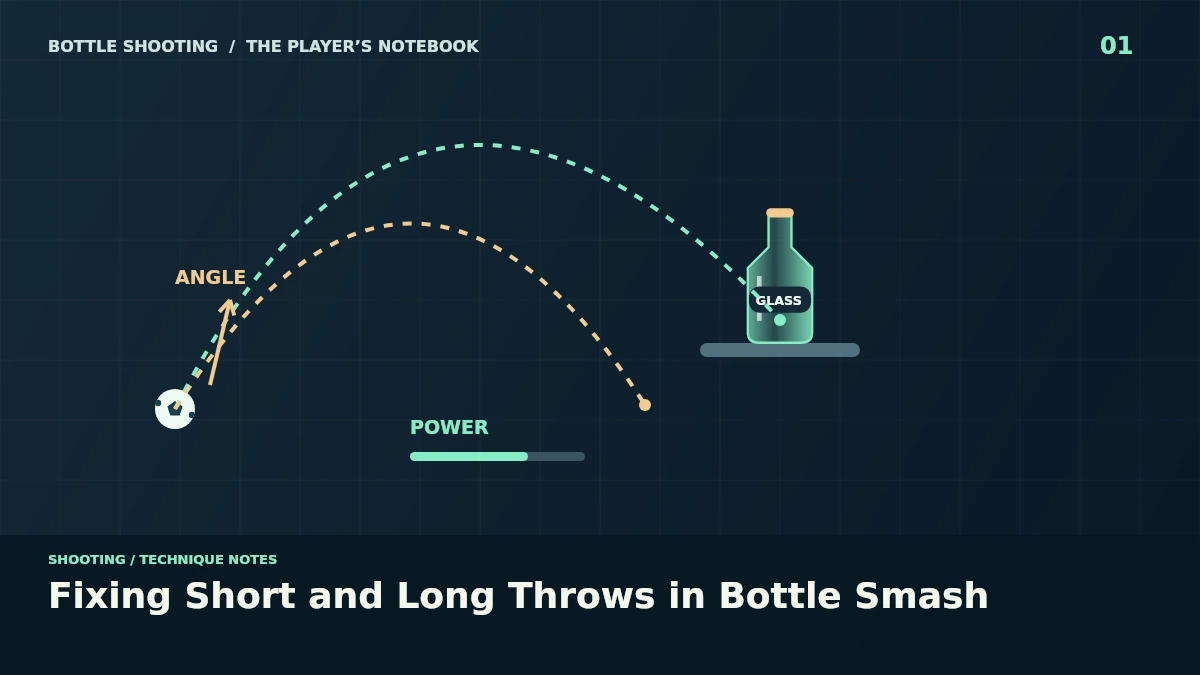
Your stone lands below the shelf. Before adding power, look at the dotted preview in Bottle Smash and check whether the arc reaches the bottle height at all.
Separate height from distance
Start with one stationary bottle. Raising the launch angle gives the throw a steeper upward component, while increasing power raises both the upward and sideways components at the current angle.
Keep the same material selected. Stones launch at 1,000 game units per second at full power, while bricks use 980 and fall under a higher gravity value, so identical settings produce different paths.
Those are internal simulation values. A phone scales the playfield onto its screen, so counting physical pixels with a ruler will not give you a useful distance measurement for the throw.
A correction you can repeat
Try this controlled practice sequence. Set the sliders to 40 degrees and 75 percent power, then choose an ordinary bottle with a clear route rather than a moving target behind a crate.
- Read where the dotted arc crosses the shelf height.
- If it crosses before the bottle, add five percentage points of power.
- If it crosses beyond the bottle, remove five percentage points.
- If the arc never rises enough, increase the angle and reassess the crossing.
Five points are a practice increment. The game does not require that particular change, but a small adjustment makes it easier to identify which setting caused the improvement or the new miss.
The crate changes the question
Is the preview ending at wood? A low throw can collide with a crate before reaching glass, and extra power may leave that same collision in the path instead of solving the problem.
Inspect the route above the obstacle. A higher angle may clear it, while a brick can destroy it in one hit and continue until its contact limit ends the throw.
Keep that distinction in your notes. Write down whether you missed the bottle, hit a crate or cracked reinforced glass, because each outcome calls for a different adjustment on the following attempt.
When wind and moving shelves arrive
Later terraces need a fresh reading. The breeze changes horizontal velocity during flight, and moving bottles can leave the position that looked reachable when you prepared the throw a moment earlier.
Use a stationary target first. Repeating a setting against a stable bottle gives you a reference for the wind before you spend another stone on a shelf moving across the same lane.
For material planning, read the brick lineup notes; for another curved projectile, compare wind corrections in Crossbow Shooting. You can find both games in the shooting games category or return to the Bottle Shooting homepage when you want a direct aiming challenge.