Why the Throw Preview Stops Before the Bottle
A short dotted line can mean a blocked route. Check what ends the preview before treating the result as a throw that needs more power.
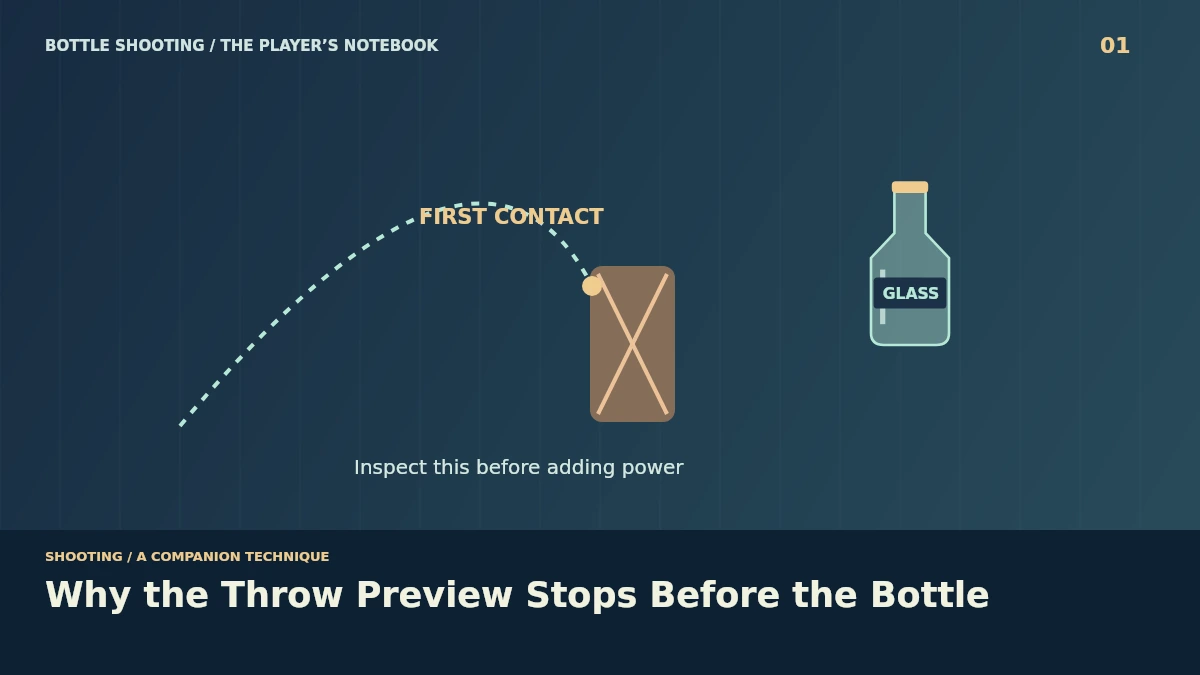
The dots stop at a wooden face. In Bottle Smash, the trajectory preview checks the first obstruction along the predicted route, so that endpoint can identify the crate you need to avoid or destroy.
Read the endpoint before the sliders
What ends the dotted line? A preview that meets glass describes a possible bottle contact, while one that meets a crate shows a collision before the projectile reaches the shelf behind it.
The guide does not choose another lane. Adding power may move the first collision along the crate face without clearing its top, leaving the same obstacle between your launch point and the bottle.
Compare two nearby angle settings instead. Keep the selected material and power unchanged while raising the arc, then check whether the endpoint moves from the crate to a reachable patch of glass beyond it.
A brick can continue beyond the preview's first contact
The dotted line ends at that contact. The actual brick can destroy a crate and continue, using part of its three-contact allowance, so the visible guide does not promise to display the full combination afterward.
A stone has another outcome. It can damage the crate but stops on that impact, meaning the same incoming lane may open the obstacle without carrying the stone onward to the bottle behind it.
Imagine the crate needs its second hit. A stone that finishes the wood still ends there, while a brick can remove the intact crate in one impact and keep traveling if its contact allowance remains.
Moving glass makes an endpoint temporary
The preview uses current bottle positions. A moving target can leave that intersection during flight, so an arc ending at glass while you aim does not guarantee a collision after you release the charged throw.
Choose a stationary shelf for diagnosis. That removes one timing variable while you check whether a low route collides with wood, then lets you return to the moving bottle with a clearer understanding of the obstacle.
Write down the kind of miss
A three-word note can help. Use “wood before glass,” “below the shelf” or “target moved away” after an attempt, because those observations point toward different corrections rather than another blind increase in power.
Keep the next test small. If the route clears the crate but lands short, switch to the angle-and-power adjustment method; if the lane stays blocked, reconsider the material or the clearance first.
For ammunition planning around special glass, read when a gold bottle returns a useful stone. Both techniques apply to games in the shooting category, and the Bottle Shooting homepage offers another aiming challenge when you want to leave curved throws behind.