Planning Mirror Bank Shots in Bottle Shoot 2
A mirror redirects a straight shot. Start with its contact point, check the reflected lane and account for barriers before spending ammunition.
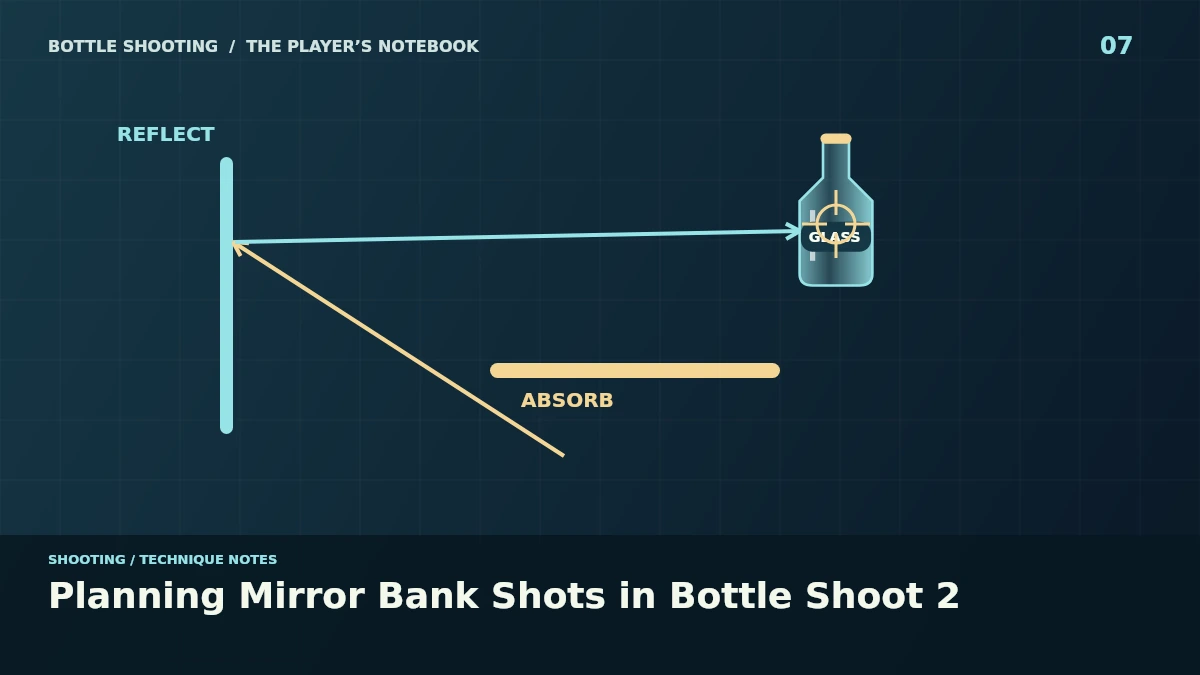
The direct lane ends at a barrier. In Bottle Shoot 2, a mirror route can approach a bottle from another side, but only if both segments stay clear of the obstacles.
Trace the first surface contact
The side mirrors arrive in stage three. They form vertical reflective segments near the playfield edges, letting you send a shot outward before it travels back across the workshop toward a bottle.
A barrier absorbs the shot instead. The horizontal obstruction introduced in stage four does not redirect ammunition, so do not treat its orange surface as another mirror when reading the route.
Start with one bank contact. For a vertical mirror, the shot reverses its sideways direction while keeping the upward component, which helps you estimate the lane after contact without adding a curved arc.
Choose a contact point with room
Imagine a bottle beside the left mirror. If you hit the mirror too low, the reflected shot may cross below the bottle body; moving the contact upward can raise that crossing.
The mirror has finite height. A line aimed beyond its top or bottom can leave the playfield without touching a reflective surface, even if an imaginary extension would have reached the bottle.
Use the preview for the installed geometry. Later stages add slanted mirror pieces whose reflection changes both direction components, so the simple vertical-mirror rule no longer describes the entire outgoing path.
The two-bounce allowance has a boundary
A shot can reflect twice. If it reaches another mirror after those two reflections, the game ends that shot rather than allowing an unlimited zigzag across the workshop until a bottle appears.
Count surfaces along the whole route. A second mirror can improve access, but a third contact consumes the shot, and a bottle collision ends travel whether the glass breaks or remains cracked.
Bank scoring requires a shattered bottle. The reflected shot carries a 75-point addition into that shatter calculation, while a hit that only damages reinforced glass earns no bottle-break points yet.
Slow the target, not the shot
Focus helps with a drifting destination. When the meter is full, it slows bottle motion for three seconds, but the shot continues moving at its normal speed and the round clock keeps running.
Read the path before activating it. That preparation leaves more of the short focus window for the actual bank attempt, instead of spending the window deciding which side mirror gives you access.
One clear route beats several rushed guesses. Test a single reflection against ordinary glass first, then apply the same contact-point reasoning to a reinforced bottle or a lane with a slanted mirror.
For nearby bottle effects, read burst-bottle chain planning; for curved routes, compare terrace throw adjustments. Explore the shooting games category for the workshop and related aim challenges, then return to the Bottle Shooting homepage when you want to compare the available games before playing.